
Pure Counterpoint
The Well-Tempered Clavier, Book 1, Prelude No. 1 in C Major: An Analysis

It’s the Easter holidays and I’m going to take a short break from Shakespeare and try something out that might be my next challenge once I have got through all of that: The Well-Tempered Clavier. This work (or rather these works) are probably the closest thing music has to a text as influential as the works of Shakespeare, and I’m interested in taking the time to really sit with the technique that underpins it. There are two books of The Well-Tempered Clavier, and each contains a prelude and a fugue (more on these genres in a moment) in every major and minor key. The sets were composed “for the profit and use of musical youth desirous of learning, and especially for the pastime of those already skilled in this study,” and they have been extraordinarily important to composers throughout history, particularly Mozart, Beethoven, Chopin, Schubert, Schumann, Mendelssohn, Brahms, and many others. It is considered essential study for both for composers and especially keyboard players and, well, it’s better late than never.
I have studied and played parts of The Well-Tempered Clavier before, particularly in my first year of university, when Book 2 was our set text. But looking back on that time I realise that, without intending to, I was focussing more on looking like I understood what was going on than really getting to grips with it. I was writing an essay a week, pointing out tonal and real answers, mentioning that stretto causes a feeling of acceleration and excitement, but usually ignoring the simple things that are going on, especially the things that are music and not fugue in particular. This is ultimately led to me not being an especially good fugue writer when I came to take that exam in third year — the fugues I ended up with broadly did fugue things, but weren’t very good music.
So my intention here is twofold: one is to get firmly to grips with the compositional processes with a focus on the apparently simple elements. That is, I do not want to be drawn into peculiarities at the expense of ordinary process and foundational technique. The other is to find ways to communicate analysis of this amazing pieces to people with different levels of understanding, and if possible to hold people’s hand through the simple to the complicated.
A little bit more about preludes and fugues. A fugue is a notoriously complex and lauded form of music involving imitative counterpoint. You will have heard and probably even sung imitative counterpoint if you’ve ever sung Frère Jaques of London’s Burning in a round. Whereas in a round, everyone comes in in order at the same pitch, a fugue has entries initially a fifth apart, and then move between different keys in a way that is controlled enough to be challenging to write correctly, and free enough that there is no ceiling to the genius that they can take. A prelude is a freer, less formal composition that precedes something (in this case, a fugue). They can be anything, in any form, and since Chopin, they don’t even need to precede anything anymore.
A final thing to say before I start is that by virtue of knowing some truly genius music theorists and analysts, who for all I know might read this, some of my readers might be genuine experts, and instead of forgiving my errors, I kindly ask that they tell me what I’ve got wrong in the comments. For Schenkerians I’m particularly nervous about my decision to depart from Schenker’s analysis by treating the tenor voice as the primary Urlinie. My understanding of Schenkerian analysis is still quite undergraduate, so maybe I’m wrong!
First, have a listen:
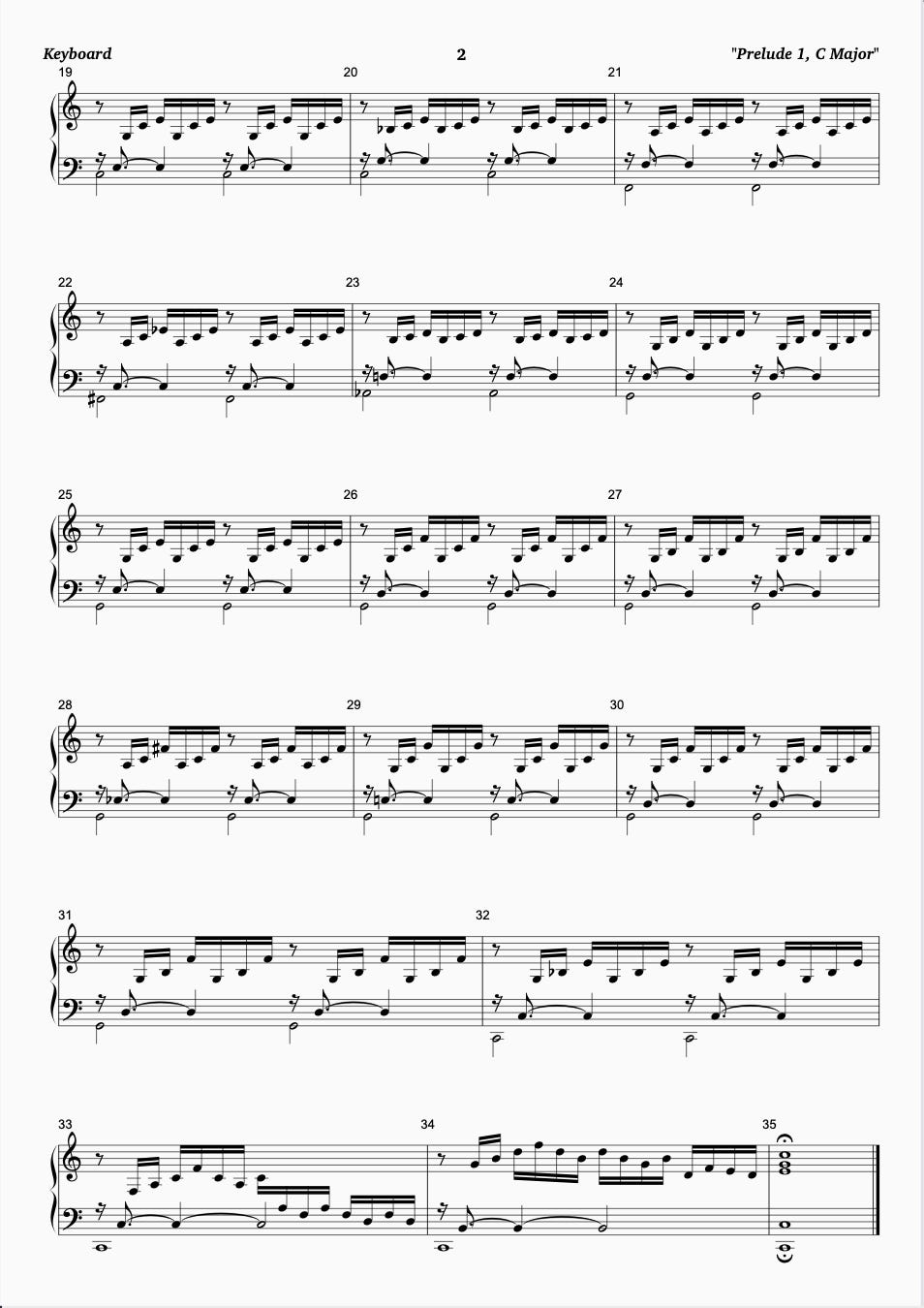
If you like, have a look:

The Pattern
This is what you will hear and see first. A simple repeating configuration, that is immediately recognisable and beautiful but also somehow unremarkable. The pattern arpeggiates a 5-note chord each time with the lower two notes sustained. There are four bars which break this pattern, three of which at the end of the piece. Working backwards on these, the final bar is obviously a moment of stasis, so the pattern ends. In the two bars leading up to it, the pattern is augmented to expand over a larger arpeggiation, to build the tension towards this moment of stasis.
The only other bar where the pattern is broken (though not completely clearly at the surface level). If you look at bar 23, if you were to try and play all the notes as a single chord, you will see that it would be a very clashy, chord, not in keeping with the style. So what is going on with that bar? Effectively, the C in that bar is a passing note, and doesn’t form a part of the more fundamental 5-voice counterpoint. In the next stage of analysis I will make an argument as to what the 5-voice counterpoint is doing in the background, but for now it is enough to say that a note in that counterpoint is doubled, which in the context of a keyboard figuration would create a gap in the rhythm, so Bach subtly replaces it with a passing note in that one bar to keep things moving.
5-Voice Counterpoint
If we take the voices implied by the figuration and write them out as whole notes, we get the following:
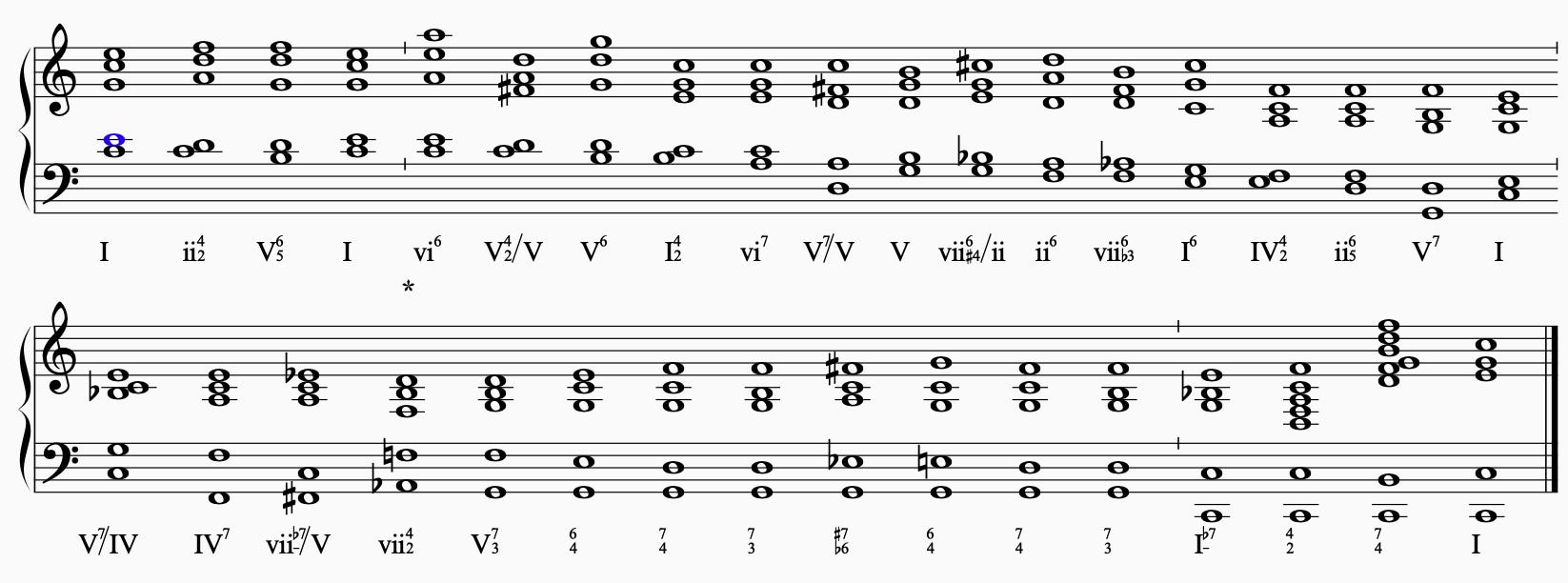
This doesn’t tell us an awful lot yet, but there are a couple of things to observe. The chord marked with an asterisk above it is the chord of bar 23 mentioned above. I have doubled the F between the tenor and alto voices. The reason I consider this the right interpretation has to do with parallel fifths and octaves, so a quick side bar on that.
Parallel Fifths and Octaves
One of the most famous rules of strict counterpoint (and the most difficult one to follow) is that parallel fifths and octaves are not allowed. So what does that mean? And why is that the rule?
There are three types of ways that two voices in a counterpoint can move against each other:
Oblique motion: one voice is stationary, the other moves in either direction.
Direct motion: both voices move in the same direction.
Contrary motion: both voices move in opposite directions.
Parallel motion is a special case of direct motion, in which both voices move in the same direction by the same amount. It is sometimes called consecutive motion because it means that two intervals between particular voices are the same after the motion in the same direction.
When parallel motion occurs at an interval which is considered a perfect consonance (fifths, octaves, i.e. intervals that, because of things to do with frequency and the harmonic series that I won’t get into here, have an especially stable sound), it has the effect of making the two voices feel like they are moving as one, thereby reducing the richness of the overall counterpoint. Parallel motion between weaker imperfect consonances (thirds and sixths) is allowed, because they don’t homogenise in perceived motion so closely.
There is also the concept of hidden fifths and octaves, less strictly forbidden, but still not considered ideal. These are any case of direct motion towards a perfect consonance. It is generally considered best practice to approach such intervals from contrary or oblique motion.
Below are a few examples in context and out of context
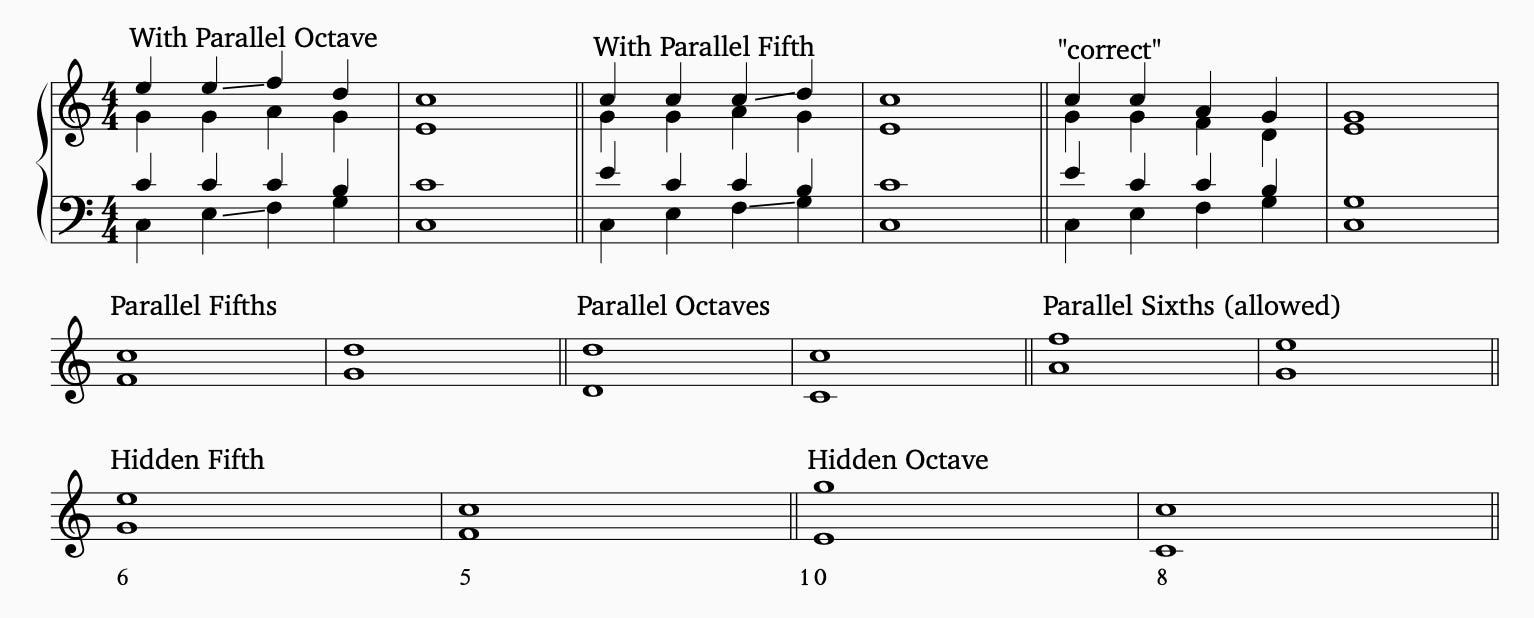
:
It can be difficult to hear what is “wrong” with these examples, because we are so used to styles that do not forbid this kind of motion, but when you’ve listened to a lot of the kind of repertoire where it is a priority, you do start to notice the effect. It also becomes clearer the fewer voices are involved.
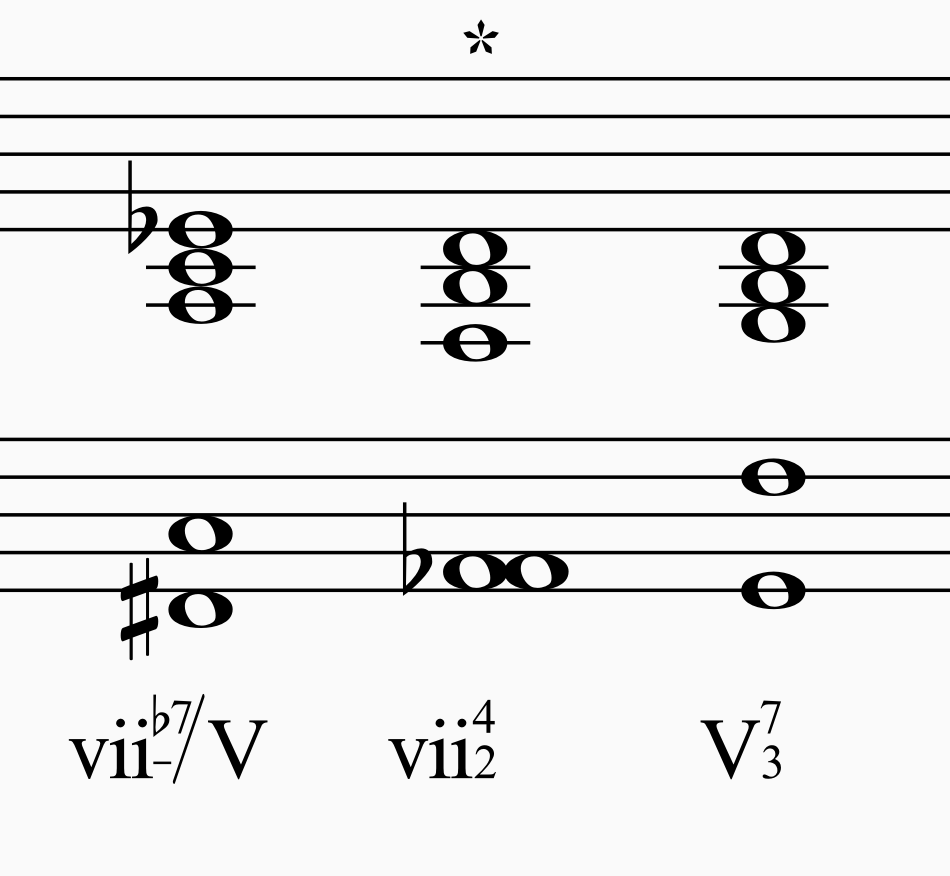
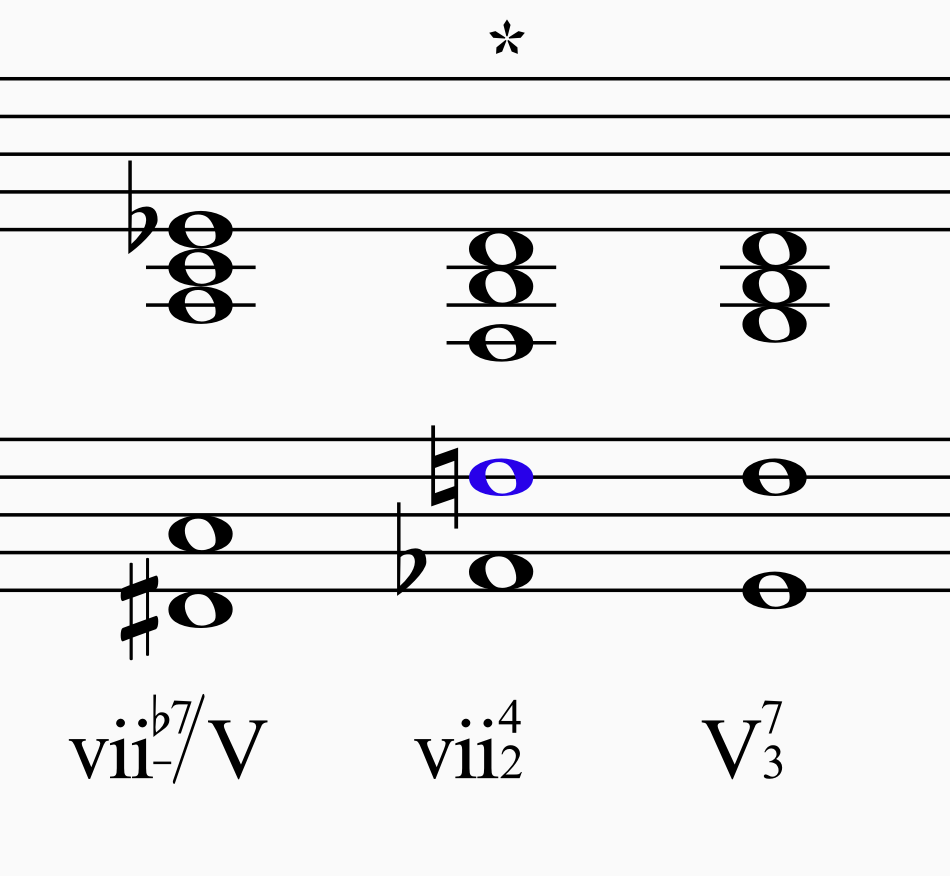
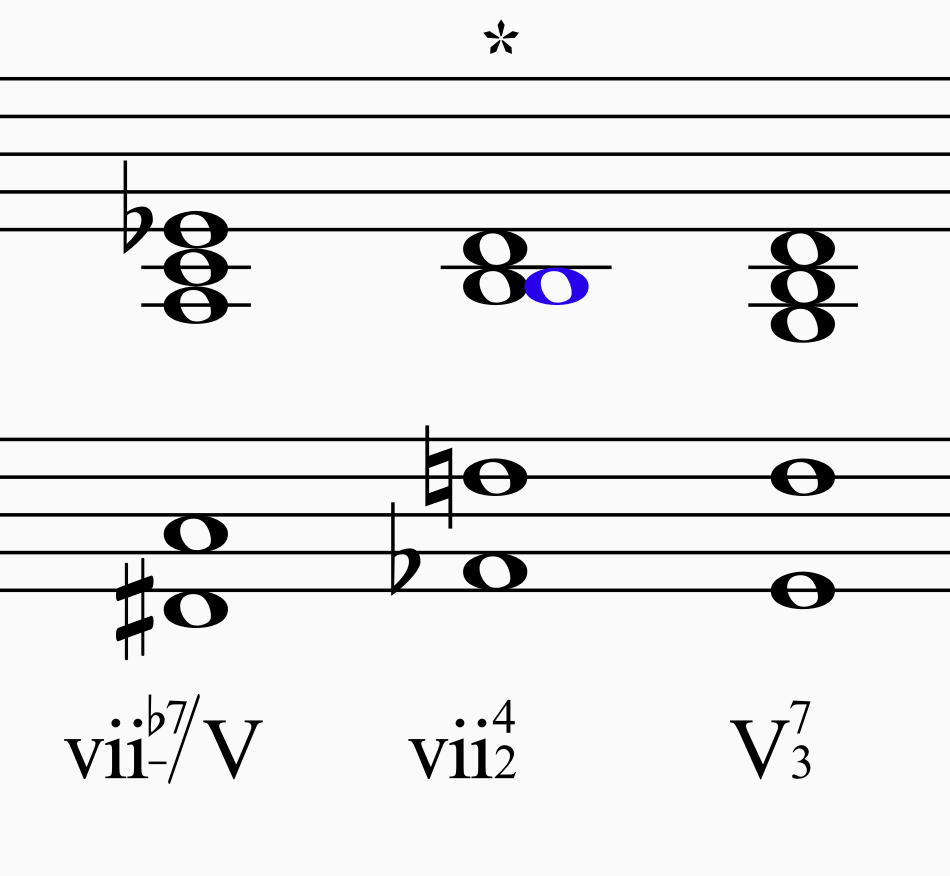
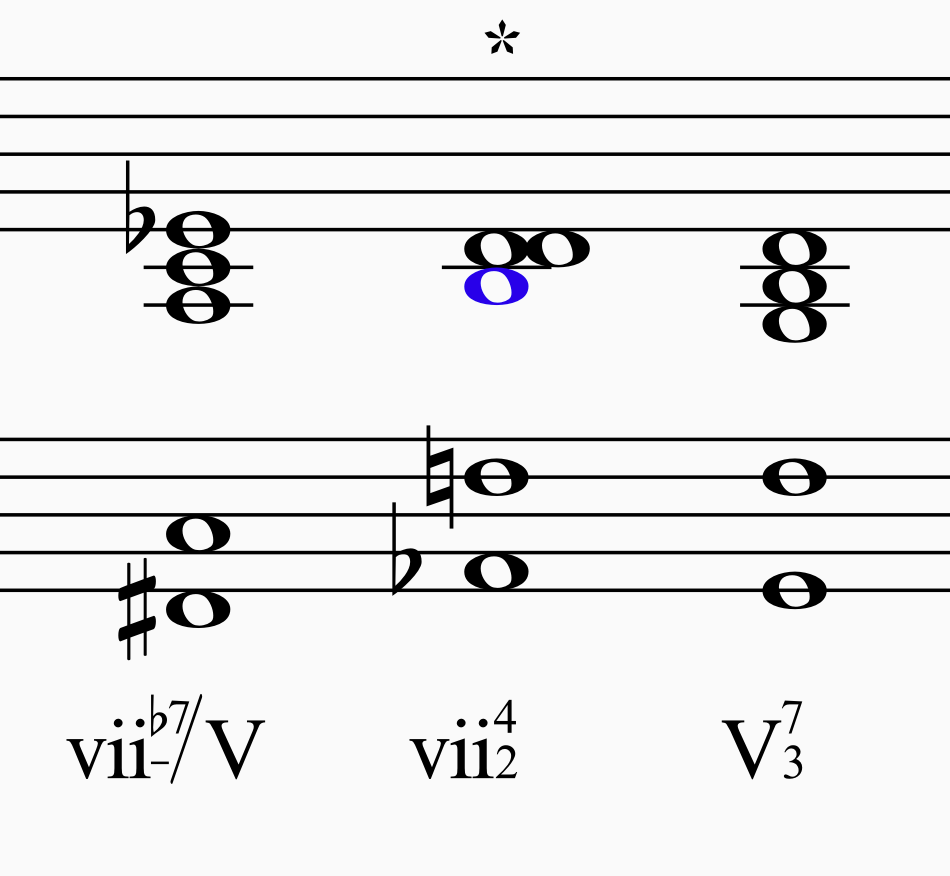
Looking back at bar 23, we can go through the candidates of doubled notes (i.e. where the fifth voice is hidden):
Doubling the Ab leads to a jumpy tenor part, and an unprepared dissonance on the following chord.
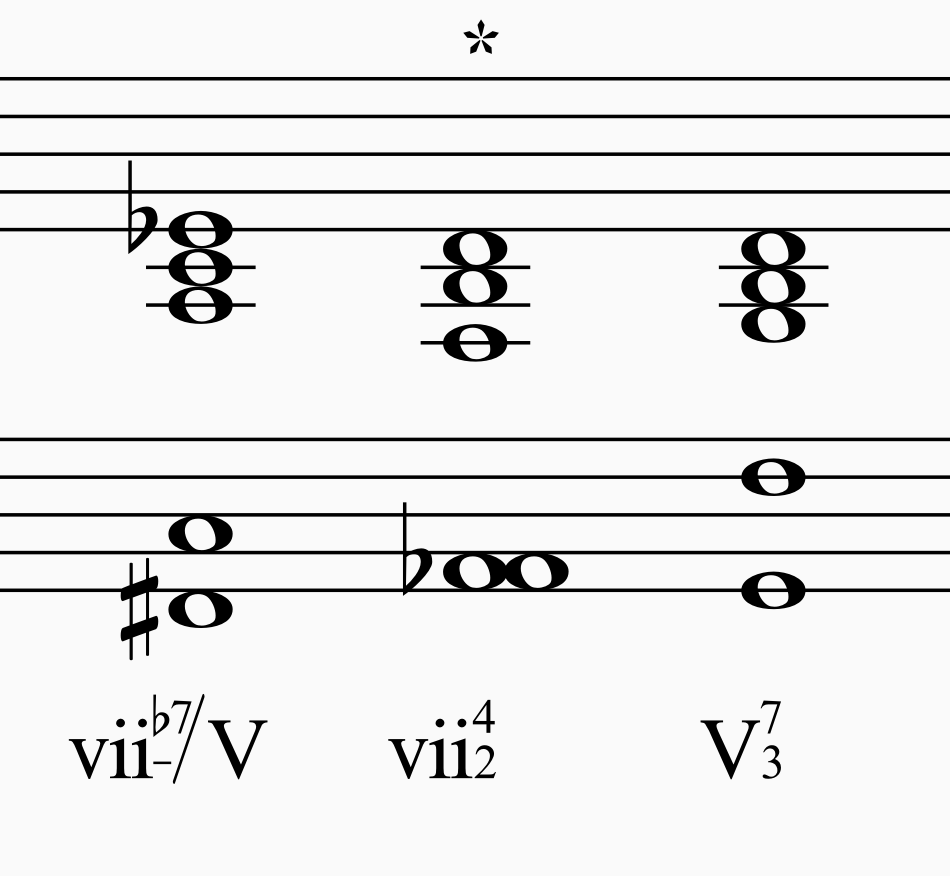
Doubling the F works, and is the option I went for in analysis.
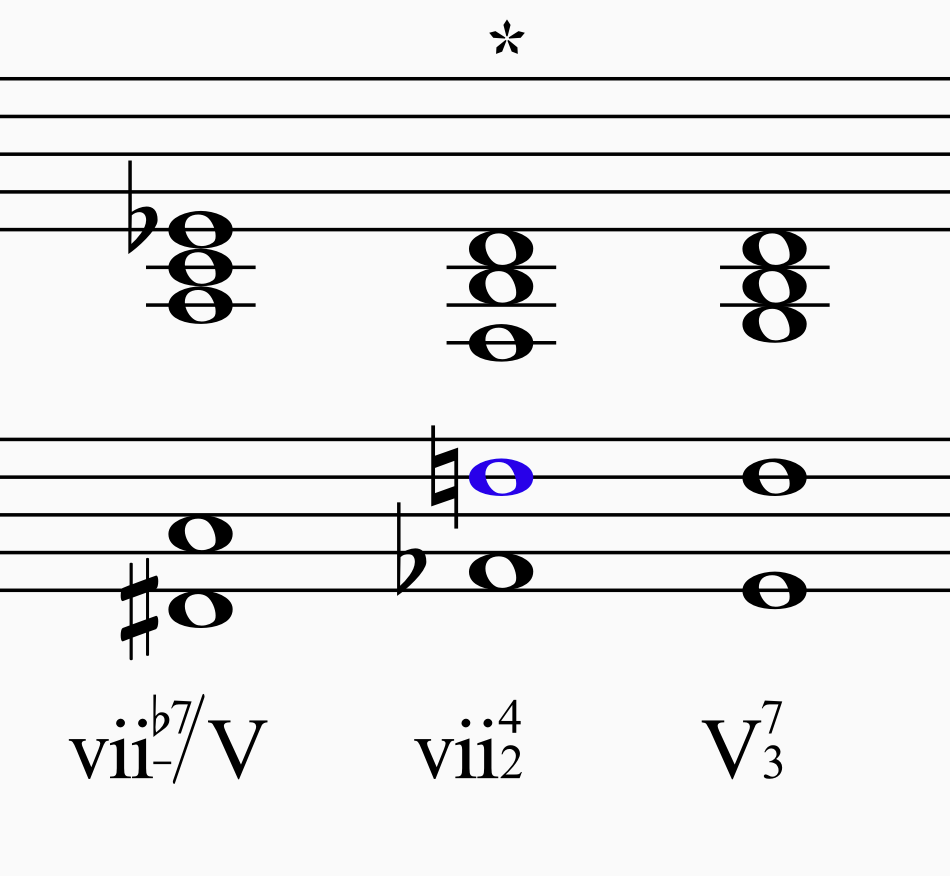
Either of the other options leads to a hidden octave between the alto and the bass parts
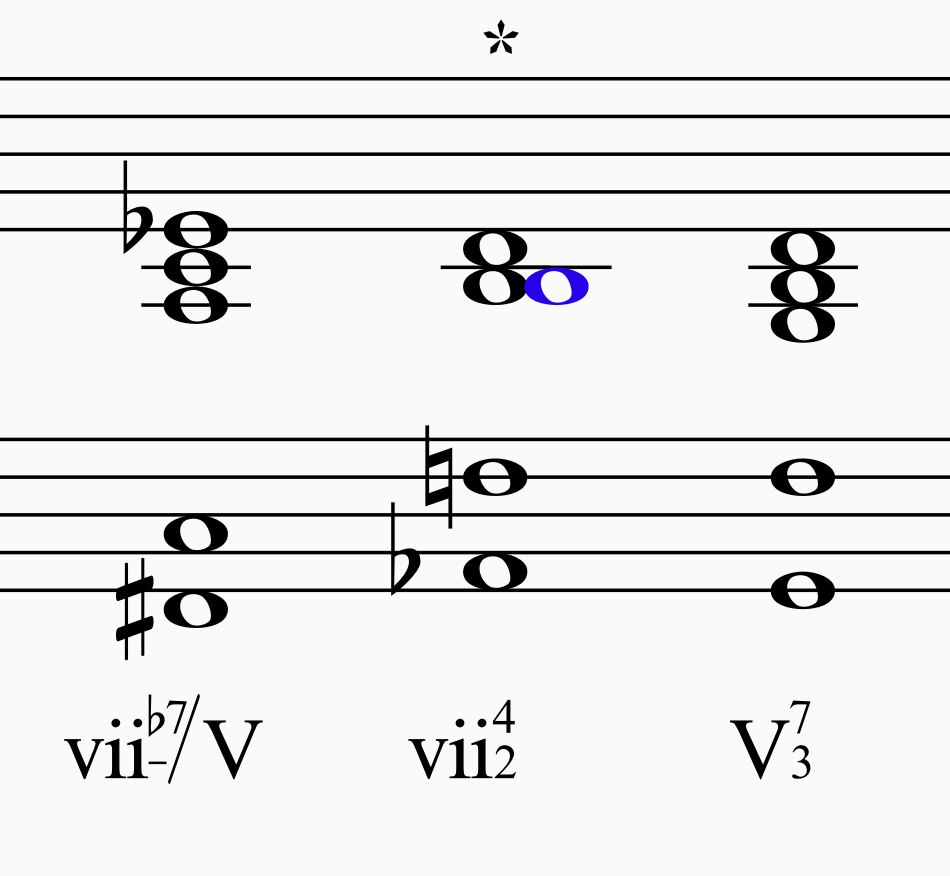
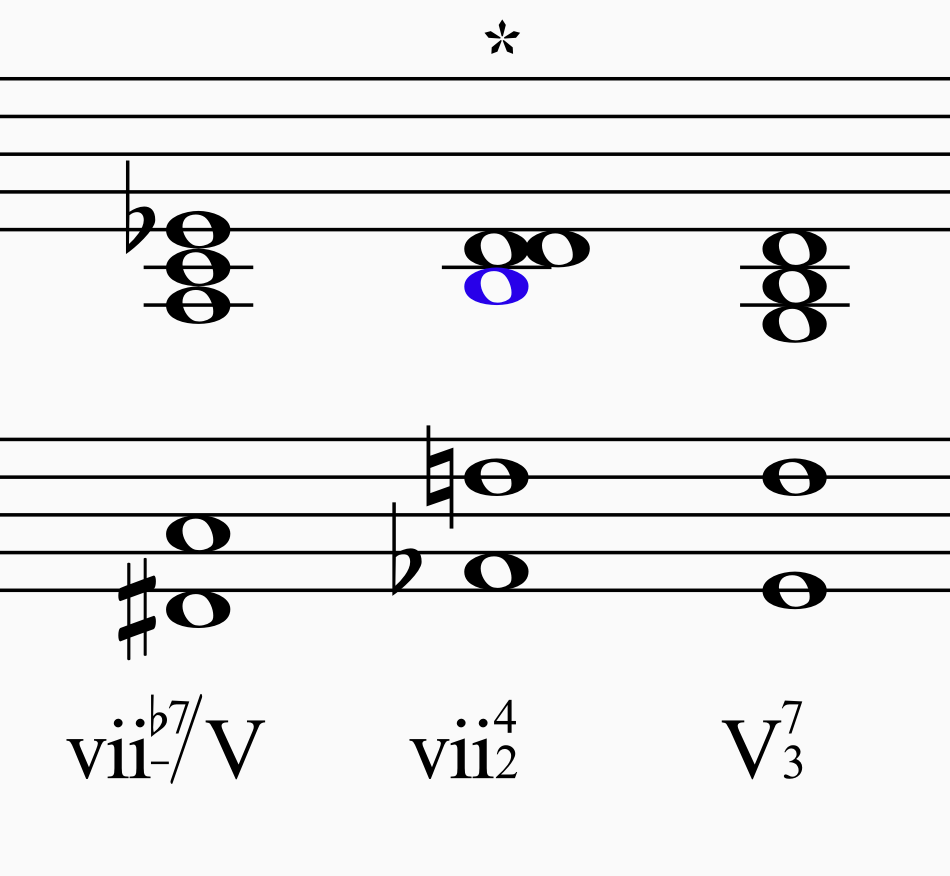
.
Graphical Analysis
Now that I’ve established the 5-voice counterpoint as a whole, this is the graphical analysis, which I will spend the rest of this post explaining.
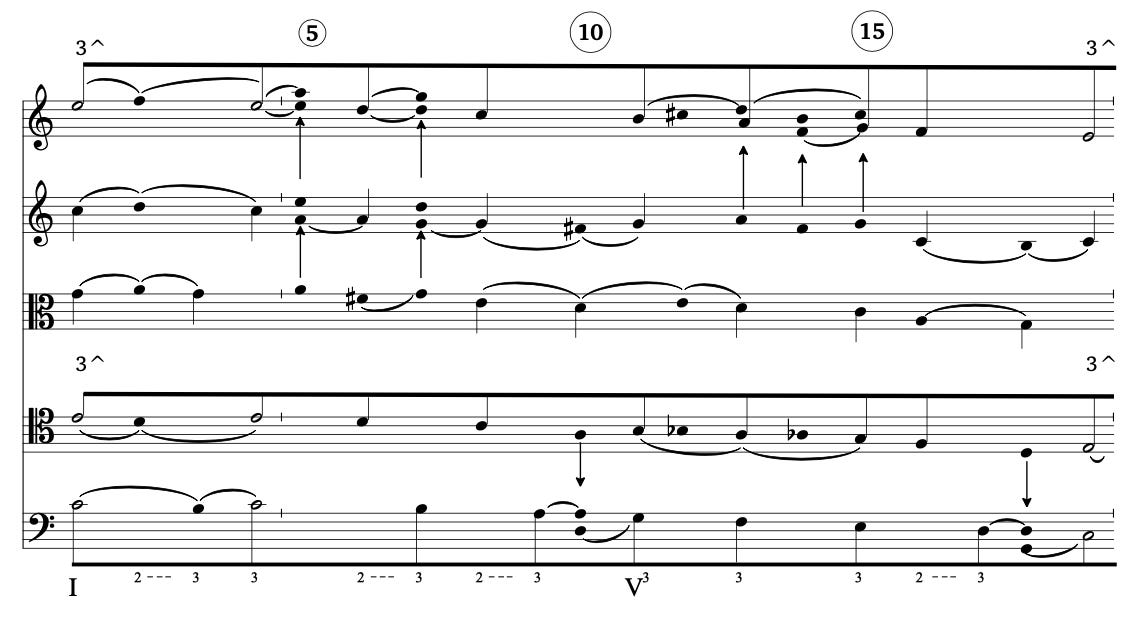
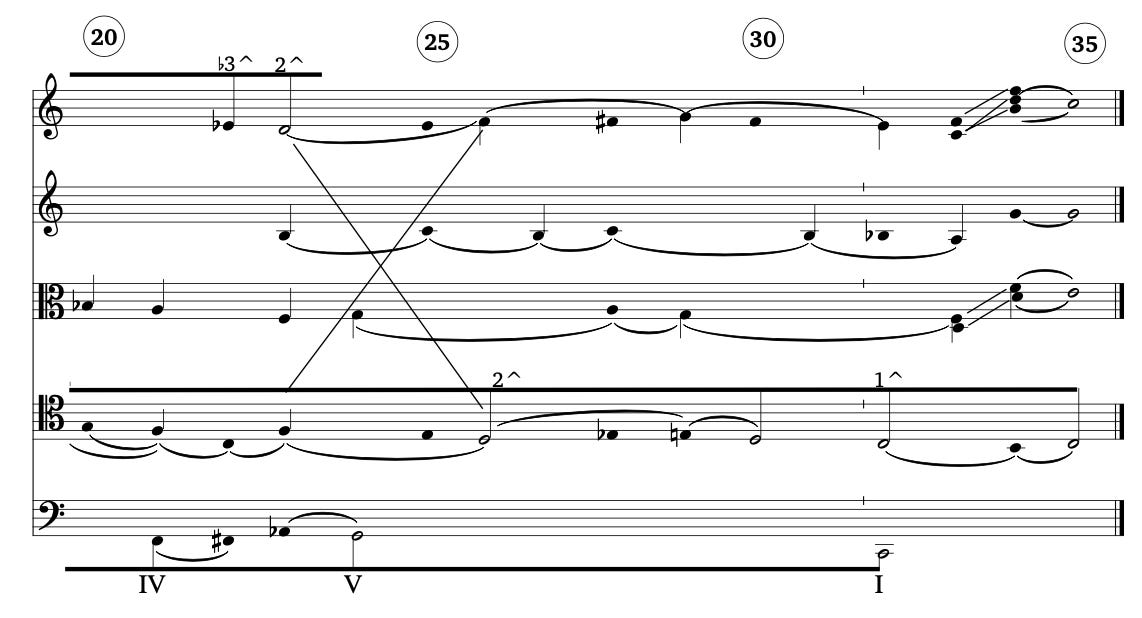
Graphical analyses like these show the hierarchical relationships between tones. Broadly empty noteheads are more structurally significant than filled noteheads, and stemmed noteheads are more significant than unstemmed ones.
This form of analysis is predicated on the idea that in music like this has a deep background structure, and levels on the foreground are propagated out through a process called prolongation.
Take a look at the first four bars (bar numbers written in circles above the system). Bars 1 and 4 are identical, and the variety between them is created by the beautifully simple mechanism of a series of staggered steps away, followed by a turn to the original tone. The top two voices move together in thirds, up for two bars and then down. The alto voice moves up in bar 2, but back down earlier in bar 3. These are called neighbour notes, in this case upper neighbour notes. The lower voices have lower neighbour notes, staggered to produce a 2-3 suspension.
A suspension has three stages: preparation, dissonance, resolution. Two voices must begin in consonance, one of them (usually the lower one) moves in oblique motion, creating a dissonance with the other, and then the voice that didn’t move resolves down by step to a consonance. The most common upper-voice versions are the 4-3, 7-6, and 9-8 suspensions. Here in this song we have the only suspension where the lower voice is the dissonance which resolves is the 2-3 suspension. These will become a feature of the prelude as a whole, and the first is in this opening unfolding sets it up.
The Voices
When I talk about ‘voices’ in this context, I don’t mean singing voices. We talk about voices in counterpoint as the individual lines within the texture. Here we have five (or do we… more on that later).
Let’s start by talking about the bass — typically the most significant voice when we are talking about tonal music. After the opening neighbour note, the bass voice gradually descends through an octave in two stages. The first stage, bars 5-11, there is a progression from C to G, the tonic to the dominant. The key of G is briefly tonicized via a secondary dominant with strong root movement, and again C is retonicized at the end of the descent by the same V-I root movement. In many analyses of this kind, you see more prolongation and composing out of a descent like this, but in this case there are very few. The line is very simple and clear. I’ve used arrows to point out moments when the descending line “borrows” from the voice above, each time as the surface bass voice reaches down to strengthen these cadences. In bar 21, the bass moves to the subdominant (IV), then through a chromatic enclosure up to a dominant pedal (V), and finally lands on I.
Now let’s deal with probably the most controversial part of my analysis. You will notice that there is one voice with a downstem beam, but there are two with an upstem beam. You will further notice (if you can read tenor clef, and my apologies for making you do that), that these lines I point out are the same. In a famous Heinrich Schenker analysis of this prelude (at least my understanding of it), the main point about this initial descent is that it is a series of descending tenths between the top line and the bass, with less significant voices filling out the texture in the middle. The argument that I make here is that our primary two voices are not the bass and the soprano, but the bass and the tenor, and that the expanded counterpoint propagates upwards, culminating at an octave doubling of the structural tenor line.
My first argument come from the 2-3 suspensions. 2-3 is a legitimate suspension, whereas 9-10 is not common practice in counterpoint, because the snap of the resolution feels weaker when at that octave remove. If you treat the main voice relationship as descending tenths you have to recognise the separate movement of the voices as a surface level event. However if we see the tenor voice as more fundamental, we can observe and understand this characteristic series of 2-3 suspensions.
Secondly, in strict two-voice counterpoint, the end of an exercise is supposed to be a perfect consonance. If we look at the top voice and the bass, when the bass hits I, the top voice is on E, the third. This is a consonance, but not a perfect consonance. Meanwhile, the tenor voice lands on an octave with the bass at bar 32, as we would expect a contrapuntal voice like this to do.
Noting the stepwise octave descent in the upper voice also requires a little more “borrowing” from the next voice down. The sequence from 11-15 sees borrowed notes forming part of the line. I’m still convinced that they form a structural doubling of the tenor voice, but it is certainly stretchier.
Finally, it makes sense with what we see on the surface of the music. The two sustained voices in this prelude are the bass and tenor, so it makes sense to see these as the primary voices upon which the upper figuration is an elaboration.
One place the upper-voice interpretation is more parsimonious is the chromatic section from 20-23. We get a 7-6 suspension over IV, passing through an Eb. The tenor voice goes a little more around the houses. But this is where the structural octave doubling becomes an ingenious device in Bach’s hands. The voices move together for the opening descent, the upper voice takes over a little, and then hands it off to the tenor voice to complete the journey. At bars 23-26, where I have written a kind of X, we have what is called a voice exchange. While the tenor voice moves D-E-F, the upper voice moves F-E-D simultaneously. As this happens, the resultant intervals is 6-8-10, a very satisfying progression which effectively hands off the voice across an octave. The effect, then, is that the tenor voice take back the mantle and move through scale degree 2 (over V in the bass) and finally scale degree 1 (over I).
The 3^-2^-1^ markings are a Schenkerian thing you don’t need to worry about. Effectively, a core tenet of Schenkerian theory is that this is a descent fundamentally in the background of all great music, over a similarly fundamental bass movement of I-V-I. I don’t know about that, but if it happens anywhere, it is here. 3^ is prolonged through this octave descent, 2^ takes its place over the dominant pedal, and 1^ lands with the bass hitting I.
The real genius here, is that two voices that at some fundamental level are essentially the same, can be expanded upon to produce voices that are contrapuntally distinct. Even though on a fundamental level, the upper and tenor voices follow one another, surface level features mean that the resultant sound can both strengthen the primary line, and create a rich five-voice texture.
I’ve not said a lot about the other voices, but there are things to observe. In the second voice (let’s call it the mezzo voice), we observe a few little neighbour note patterns, first on the tonic, then on the dominant, then on the tonic, then hangs around B, before descending through A to G, at which point it hops up the octave with all the upper voices. I can’t think of much interesting to say about the alto voice, but it’s there, plugging away, being essential to the sound, as every good alto does (and we love them for it).
The important thing to note overall is that we can analyse a piece of music at multiple levels. We’ve looked at the surface, we’ve looked at the five-voice counterpoint, and we’ve looked at the fundamental counterpoint of which it is an expansion. What might remain to be said is that I’m not claiming that Bach would have written these fundamental lines as I’ve called them and then decided to expand on them. This prelude, like many of Bach’s compositions probably originated from a bit of improvisation that he rewrote and refined over the years, teaching it to students who would copy it out to practice and eventually honing it into what he compiled in The Well-Tempered Clavier. Almost everything I have pointed out will have been driven primarily by his ear, speaking counterpoint as a native language as only a few brilliant composers ever have, and hearing progressions over full structures. It’s something we can only strive for!
Goodness me, this went in depth. I’m pleased I went in depth, but this little experiment has told me that should I get to this point, I won’t be able to do it weekly like the rough Shakespeare reviews I’ve been doing recently — this took me a very full day to write and make figures, and I’d already been casually analysing in spare moments for around a week, having known this piece fairly well for a long time. I was thinking of possibly pairing it with a ground up study of counterpoint in the Fuxian mould. I worry that might make for boring content, but who knows. Besides, I have 30 plays left before I run out of that particular well.
I hope at least some of this was insightful and comprehensible. I got more technical as I went, but it is a challenge I’ve not yet mastered to explain a graphical analysis in prose. I just hope I’ve captured some of the technique that contributes to the magic of this composition!
Back to Shakespeare next week with Measure for Measure.